
Natural vs. Lab-Grown Diamonds: What You're Really Paying For
There's a reason "diamonds are a girl's best friend" has stuck around for nearly a century. It was never really about carbon and crystal structure — it was about the way a stone catches the light at just the right moment, the way it sits on a hand that's said yes, the way it gets passed down until it's carrying three or four generations of stories instead of just one. That romance is exactly why this question comes up so often in our showroom: does a diamond need to be a billion years old to earn that kind of devotion?
Here's the science, plainly: ask a gemologist to tell a natural diamond from a lab-grown one using only a standard jeweler's loupe, and they can't do it. Both are crystallized carbon arranged in the exact same lattice structure, with identical hardness, brilliance, and fire. The only meaningful difference is origin: one formed a billion-plus years ago under immense heat and pressure deep in the earth's mantle; the other formed in a lab, in a matter of weeks, under conditions engineered to replicate that same process.
So if the stones are identical, why does one cost four to six times more than the other, and why do so many of us still feel a pull toward the natural stone? The honest answer has less to do with physics and more to do with story, scarcity, and what a diamond is meant to represent.
Does Time Add Value?
This is the question at the heart of the debate, and it's worth sitting with rather than dismissing.

A natural diamond's timeline is genuinely extraordinary — it was likely forming before complex life existed on land, quietly waiting under the surface long before anyone alive today, or their great-great-grandparents, ever existed. There's something almost impossible to manufacture in that fact alone. A lab-grown diamond, using either high-pressure high-temperature (HPHT) or chemical vapor deposition (CVD) methods, reaches full size in a couple of months at most. Whether that geological history adds value is a matter of perspective, not measurable fact. The diamond itself doesn't perform differently for having taken longer to form — a lab-grown stone won't scratch more easily, sparkle less, or wear out sooner. What natural formation offers is a narrative: rarity, permanence, a physical link to deep time, and for a lot of us in this industry, a bit of irreplaceable magic that no lab timeline can quite replicate. For many clients, that story is a significant part of what makes a diamond feel meaningful — the sense that they're not just wearing a gem, but holding onto something ancient that chose, in a sense, to end up on their hand. That's especially true for engagement rings or heirloom pieces meant to be passed down, where the stone is meant to outlast the person wearing it.
Lab-grown diamonds offer a different kind of story: precision, sustainability, and accessibility. There's real appeal in choosing a stone that didn't require large-scale mining, and in being able to afford a larger, higher-clarity center stone for the same budget.
Neither answer is wrong. The value of "time" is something each client assigns for themselves — and that's a conversation worth having with them directly, rather than deciding for them.
What Lab-Grown Diamonds Are Doing to the Industry
The impact has been fast and structural, not incremental.
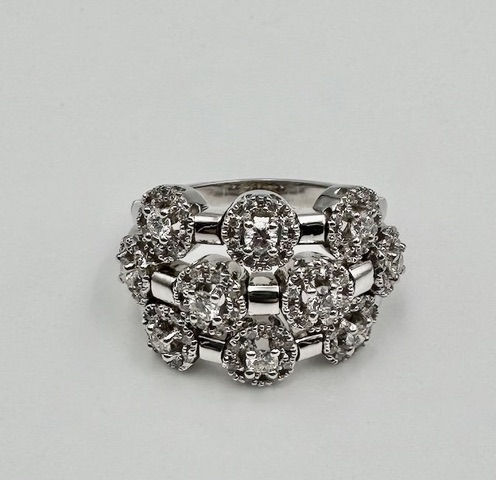
Prices have collapsed — but they're stabilizing. Lab-grown diamond prices have fallen roughly 65–75% since 2020, driven by rapidly scaling CVD production out of China and India. That freefall appears to be leveling off: premium, certified stones are approaching what analysts consider a production-cost floor, with the steepest declines now mostly behind the industry. Natural diamond prices have also softened, down roughly 8–12% from their 2022 peak, but far more modestly — reflecting a finite, mined supply rather than a manufacturing process.
Market share has shifted dramatically. Lab-grown stones now account for close to half of U.S. diamond engagement ring purchases, up from a niche category just a few years ago. That shift has pushed average engagement ring spending down and pushed average carat size up — lab-grown buyers are often choosing significantly larger center stones for the same budget a natural-diamond buyer would spend on something smaller.
The market is bifurcating, not merging. Rather than lab-grown diamonds simply replacing natural ones, the two are settling into distinct positions. Lab-grown is establishing itself as accessible, everyday luxury — a way to buy more stone for less money. Natural diamonds are repositioning around exclusivity, provenance, and long-term value retention, since limited supply gives them more predictable resale value than a manufactured product with a falling production cost.
Resale value remains the clearest practical divide. This is the one area where the chemistry-is-identical argument doesn't fully apply. Because lab-grown diamonds can be produced indefinitely and their cost continues to trend downward, they don't hold resale value the way natural diamonds do. A natural diamond purchased today is more likely to retain a meaningful share of its value years from now; a lab-grown diamond, priced against an ever-cheaper new supply, generally won't.
What This Means for Clients
For a jewelry brand, this isn't a debate to settle — it's a distinction worth explaining clearly so clients can choose with confidence. Some will want the story, rarity, and resale stability of a natural stone, and the quiet thrill of knowing their diamond has been around since long before recorded history. Others will prioritize size and budget, and lab-grown will be the obvious answer. Both are genuine diamonds in every measurable sense; the choice comes down to what a client wants the stone to mean, not which one is more "real."
Sparkle, Either Way
Here's what doesn't change, no matter which stone a client walks out the door with: a diamond earring still catches the light across a crowded room. A diamond ring still tells a story every time a hand moves. A diamond bracelet or necklace still turns an ordinary outfit into an occasion. Whether that sparkle formed a billion years ago or eight weeks ago, it still does exactly what diamonds have always done — it still makes someone feel like the best version of themselves. Diamonds earned their reputation as a girl's best friend one wearer at a time, not one origin story at a time, and that reputation isn't diminished by where the stone came from.

That's a conversation b. shannon designs is well positioned to guide — with the facts on the table, the nostalgia honored, and no pressure toward either answer.


Comments